
This should top the list of walks on Exmoor to do before you die – or before you become too halt and lame at least. We parked in the County Gate car park, not one to receive rosettes for scenic beauty with its boxlike public convenience and boarded-up National Park Centre. On a glorious July day, however, this eyesore was immediately forgotten as we walked across the road and down to the coastal path with stunning views already over the sea. On the path someone was busily setting up a water station for a run from Countisbury to Minehead as we turned left down the track towards the Glenthorne nature reserve. We were soon in mixed woodland and then a pinery, with the sea blue beneath us through the trees. We came across a weird cistern with a cross on top and, after we had turned right into a driveway, two pillars topped with boars’ heads. Just past this impressive gateway, there was a fine lodge house with latticed windows but, within yards, the path left the driveway and led us high above what was presumably Glenthorne House. It would have done if the Reverend Halliday’s gothic country house was still standing but, like Ashley Combe House further north, apparently it had gone.

It was no matter as the views over the sea from the path were to die for, with numbers of small combes down which streams rushed towards the rocky beaches. A walker coming in the opposite direction warned us of “two coach loads” of runners heading towards us and, sure enough, soon they appeared in their singlets and flimsy shorts, puffing and sweating. They had twenty one miles to cover, and on a baking hot morning I earnestly hoped that they would not suffer the fate of the original marathon runner who brought the news to Athens of the great victory at the eponymous battle - after delivering his message he dropped dead on the spot. Feeling particularly smug, we continued on our even-paced way through shade and shadow, unaware that we all too soon would face a fate perhaps worse than death.

Just before Foreland Point we emerged into the full force of the blazing sun and, after following a service road to the lighthouse between steep gravel-patched hillocks, we turned left into a path which climbed steeply upwards towards Countisbury. To our right was a magnificent view of Lynmouth and its beach before the top of Countisbury church tower popped up over the skyline. We passed through the church yard and out between an avenue of yews to find the busy Blue Ball pub directly in front of us.

Like a good hound, however, we kept true to our line and passed by the tempting open door, keeping ever before us an image of our intended waterhole, the Rockford Inn. This mental picture had been much influenced by reading an often hilarious blog by a former licensee of the Rockford Inn on how he bought the pub and attempted to drag it screaming into the present century. His struggle to prevent passing coach parties from using his lavatories without buying a drink, and to keep his dipsomaniac customers under some form of control, is an epic of Homeric proportions. Curiously, the narrative stops abruptly. Perhaps, he threw himself into the East Lynn river.
The bridleway to Watersmeet could be clearly seen from the churchyard and, after turning left and then crossing the main road, we turned our back to the sea and set off over the ridge southwards. We passed through a grassy lane, down some pasture, and eventually into woodland. The path narrowed and then snaked downhill through a succession of hairpin bends. We ignored the first path to Rockford and Brendon, determined to reach the bottom of the gorge and to see Watersmeet itself. It was the first Sunday of the school holidays, hordes sunned themselves on the rocks, and the National Trust tearoom was in full swing. As usual with the National Trust, the institution which has allowed the middle classes to inherit the earth, the lavatories were immaculate. We took a picture of the two rivers and fled up the valley towards Brendon.

This river walk is one of stunning beauty – cascading waterfalls and churning rapids framed by the arched greenery of the trees. Sometimes the flow of the water pauses to form deep, still pools. On such a scorching day only the occasional appearance of other walkers dissuaded you from stripping off and sliding into the dark water. It was a magical experience.


The appearance of some cottages announced our arrival at Rockford. The pub was clearly visible on the far bank, and we found the footbridge and crossed into the sunlit lane where a sign confidently announced not just the Rockford Inn but that it had its own microbrewery as well.
Did it, hell! It was closed. A passer-by could tell us that the pub had been sold and that the new landlord was due to open the next day. This was not much consolation to two hot and very thirsty walkers. Somehow Slim Dusty’s wonderful ballad “A Pub With No Beer” came back to me, “There’s nothing so lonesome, so dull, or so drear, than to stand in the bar of a pub with no beer.” We couldn’t even get inside. The best my internal rhyming dictionary could provide me with to sing as I stormed off up the lane to Brendon was, “There’s nothing to hit you so hard in the gut as to stand at the door of a pub that is shut!”


This was a real crisis. It was 1.45 pm. Could we reach the Staghunters Inn at Brendon before they called last orders? We made it in a hack canter by two o’clock. No closed door here… the blessed shade of the bar after the glare of the sun… a welcoming landlord… and on the pump – Cotleigh’s divine Barn Owl. Barn Owl is a sort of junior version of Buzzard. It’s a dark copper beer which drinks like a summer porter, and we didn’t need the recommendation of the two gentlemen playing pool to order up two pints. The world suddenly seemed a much better place as we sat at the bar opposite to the sepia photograph of an Edwardian meet of the Staghounds, and listened to the lady opposite complaining that her pool-playing husband’s lunch was spoiling. We sympathised with him; better a pint of Barn Owl than the roast beef of Old England. Apparently, the Rockford Inn had been opening only sporadically for some time. Let us hope that it may be about to enter on a period of new prosperity. We will give it a second chance – but we’ll check that it’s open first.

We walked on to Leeford Green, and turned left over the river. We ignored the sign that claimed that the road was closed and turned right to Hall Farm where we took the steep path which led us along the side of the valley. Where the valley swings right round towards Dooneland, we kept left past Ashton Farm and then climbed over the moorland, with views towards Badgworthy, until we suddenly we were looking down on County Gate.
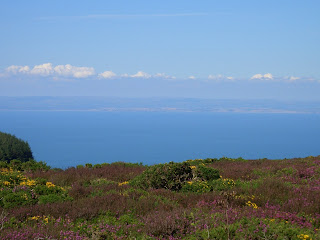
Welsh coast from above Ashton Farm

Doone Valley from Ashton Farm
The good news is that the Rockford Inn is open again. Recently we returned to have lunch there. The top half of the stable-type door was open, leading into a pleasant, half-timbered room. The bar was stencilled with information about the pub, the river, and the fishing, and “Lorna Doone”, and you stepped up into a further room into which the bar extended to be served. To the side of this, through an archway decorated with a pleasant mural of fox, stag, and hare, was another room, and beyond that there was another available if the pub was packed. Each had its own fireplace or wood-burning stove. There’s also a small terrace on the other side of the road overlooking the river and the footbridge. Proper beers, served straight from the barrels racked up behind the bar, were Cotleigh 25 and our favourite Cotleigh Barn Owl. We had a cheap lunch off toasted sandwiches at little more than £3 each plus a bowl of chips for £1.50. Baguettes were a quid more than sandwiches. There’s every hope that the new team will prosper as it deserves. Several passing walkers came in on a Friday lunchtime. The pub is open every evening, and every lunchtime except Mondays.


