
It was the best of October mornings with a chilly sun and the light as clear as cool water. We started from the public car park behind the Foresters Arms, (the blue sign is barely visible as you approach the village from the south,) and walked past thatched cottages and across the mediaeval Gallax Bridge to take the bridleway up through the old woodland towards Bats Castle. The trees here tower above the steep path and, where a broad path curves round to the left, you need to be careful and take the steeper way to the right.
 Soon we were on to open moorland and the path took us over the two ramparts into the centre of the Iron Age encampment of Bats Castle.
Here to the north there were stunning views over Dunster towards the Welsh Coast.
 To the west we looked towards Dunkery.
The broad path continued through open ground until we reached the trees again at Withycombe Gate. Here there was a somewhat equivocal sign to Withycombe but, after one false start, from the gate we inclined to the right and then after just a few steps took the next path on the left. An old boundary wall was to our left as we emerged again from the forestry and walked along the top of Withycombe Hill.
Eventually the trees fell away to our left and we walked down through open meadowland towards Withycombe. Below us Minehead and the exotic far pavilions of its holiday camp were clearly visible. “In Xanadu did Billy Butlin a stately pleasure dome decree, where Avill the sacred river ran, through caverns measureless man, down to an occasionally sunlit sea.”
Eventually the trees fell away to our left and we walked down through open meadowland towards Withycombe. Below us Minehead and the exotic far pavilions of its holiday camp were clearly visible. “In Xanadu did Billy Butlin a stately pleasure dome decree, where Avill the sacred river ran, through caverns measureless man, down to an occasionally sunlit sea.”

 The path eventually becomes a farm lane with steep banks on either side, and Withycombe came upon us suddenly.
The church, which had been obscured in dead ground throughout our descent, was both a surprise and a delight. In the bright sunlight the lime-washed walls dazzled.
 Inside we found a beautifully carved rood screen. It had been worked by Flemish craftsmen living in Dunster sometime in the 1500’s.
 We walked round the church and turned left into the lane which leads out to the main road between Watchet and Minehead. We passed a converted schoolhouse which boasted the original name of “Terms End” and more than one substantial farm. They make a remarkable contrast to some of the battered homesteads on top of the Moor. Here the low and rich flatlands close to the sea grow asparagus and potatoes, not just gorse, bracken and heather.
We successfully diced with the traffic on the A39 at Withycombe Cross before diving into a green lane exactly opposite, marked on the map with the splendid name of “Black Monkey Lane”. I don’t think that this mysterious simian, or anyone else, had been down it for a long while. We wobbled our way uncertainly through the docks, nettles, and long grass, but eventually the track became more open. Where the path began to curve to the right, we passed through a gate on our left, which is weighted by a line to ensure its closure, and then headed straight across a big pasture to the opposite gate towards Marshwood Farm. Ignore the stile on the left of the weighted gate. It leads nowhere.
Marshwood Farm is an imposing if plain building, but with an impressive porch, the stone of which may have come from nearby Cleeve Abbey.
 The footpath passes through the middle of the farm and its buildings before it leads you out into the public road. Here we turned right and walked into Blue Anchor over the level crossing of the West Somerset railway.
 We turned left on to the beach to walk back to Dunster. There is no actual coastal path here, and the easiest way of going is to walk on the beach itself just above the tide line. Nearer the railway the large, flat pebbles can be difficult to walk over.

As we neared Dunster Beach, we passed the mouth of the River Avill flood defence scheme. The concrete channel stretched away and out of sight and, even on such a lovely morning, seemed oddly threatening and apocalyptic. No doubt feet in Dunster keep all the dryer for it.

Soon we reached Sea Lane End, and we left the beach to walk along the road towards Dunster. A steam engine, all brass and smoke, puffed along the railway through the fields. We crossed the lines and, as we reached the first buildings of the village, we turned left into a footpath which ran along the side of the River Avill. It took us back to the main road at Loxhole Bridge and on into the parkland surrounding Dunster Castle.
The path ended at the top of the main Dunster car park, and we walked through the main street, past the yarn market where a busker in eighteenth century dress was playing an amplified dulcimer. Dunster’s that sort of a place.
The path ended at the top of the main Dunster car park, and we walked through the main street, past the yarn market where a busker in eighteenth century dress was playing an amplified dulcimer. Dunster’s that sort of a place.
 We negotiated Exmoor’s only traffic lights and were now in search of our goal, the Stag’s Head, reputedly the oldest pub in Dunster.
 It was closed. Thursday lunchtime on a sunny October day in Exmoor’s most popular tourist trap, and it was closed? Words, even the most vulgar, for once failed me.
 The Stag’s Head is fortunate indeed to be able to indulge in taking time off on a Thursday during the season. Five Exmoor pubs are advertised for sale at the moment - from which you may draw your own conclusions - including the “Foresters Arms” in which we took refuge for the second time in a week. The beers had changed and, without being asked, the landlord kindly poured us samples of Old Peculier and a new brew, Cotleigh’s Nutcracker. Nutcracker is a good, old-fashioned mild; dark in colour and flavour but light on alcohol at 3.4%. I can remember old gents drinking mild and bitter when I was a lad. Nutcracker made a delicious lunchtime drink.
We took our glasses to the end of the bar, where Nelson, the pub parrot, rules from his roost. We tucked ourselves away in a comfortable corner of dark panelling under a splendid cartoon from the 1950’s depicting the pub’s skittle team.
 From his cage Nelson seemed to be watching the news channel on the TV high up in the corner opposite the pool table. Famous politicians at a party conference passed silently across the screen. After a few of his favourite whistles, Nelson made his own apposite comment in a rich West Country accent. “Wanker! he squawked, “Wanker!”


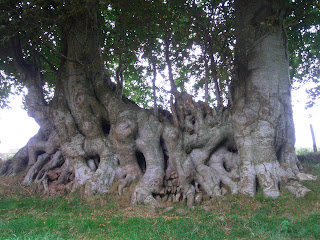


 The track wound through woodland until it tipped us out into the road again and, when the Beech Tree crossroads was in sight, we turned left off the road and started to climb up to the forestry on Croydon Hill. Here Christmas trees stand in regimented ranks but there are good views to the right over Luxborough and the Brendons.
 Soon we reached the open moorland of Withycombe Common. There is a bewildering choice of paths here, but we took the track signposted to Dunster which led past the summit of Black Hill and down past the deliciously named Withycombe Scruffets. There were grand views over the Bristol Channel towards Hinkley Point and then the track passed into old woodland.
 We are still not sure where we went wrong. It may well have been where we forded a gated stream and went straight on up a steep bank. We probably should have turned left, to take us as intended to Withycombe Hill Gate. Instead we floundered along on to Withycombe Hill itself and only the use of a compass led us back in the right direction.


