
Railway posters for British seaside holidays are an art form in themselves. The sun always shines, yachts scud across an azure sea, improbably shaped bodies chuck beach balls at each other, and children play on improbably golden sands. As a small boy, I stared fascinated at the ones which decorated the compartments on the trains from our village station. I even went by train for our annual seaside holiday at Burnham-on-Sea and still managed to forgive the posters for the lies which they cheerfully peddled. Such is the seductive power of art.
We found this one outside the Minehead terminus of the West Somerset Railway. These resuscitated railways are fantasy made flesh, or at least steam, smoke and metal. The stations are immaculately painted in the old colours of the Great Western Railway, and the flower beds are lovingly tended.
 It only needed a whiff of a paraffin lamp and of Jeyes Fluid in the Gents and I could have imagined Mr Gate with his whistle and flag still standing on the Hallatrow platform as we set off for Mells Road. We clambered into an old carriage and the locomotive chuffed off northwards, leaving a tattered ribbon of smoke hanging over the fields. At Blue Anchor the line ran so close to the tide line that the train seemed to running along the edge of the waves.
  We clambered out at Washford and walked along the busy A39 to find the footpath leading back towards Minehead. It was well-marked through some old pastures and eventually became a track. As we climbed there were good views towards the coast as far as Minehead, and above us brooded the tops of the Brendon Hills.
 We were only just outside the boundaries of the National Park, but this rich farmland seemed a world away from the moors and marshes of Exmoor proper. Here stubbles had been cultivated and in some fields winter cereals were already well-advanced.
When we reached a three-way cross, we went straight on up the narrow lane until we reached a house called Forche’s Gardens. Here we turned right and followed the track to Escott Farm, passing in front of its handsome buildings and then through a belt of woodland. We marched forwards through a succession of gates and fields until we crossed a fenced alleyway of well-tended grass. This was the top of the racehorse gallops belonging to Sandhill Farm where Philip Hobbs trains one of the most successful strings in National Hunt racing. Far below us we could see the ranks of schooling jumps.
  We passed through a gate into some rough woodland, and it was soon after we emerged from it that we made our only mistake of the day. The footpath sign directed us to our left to follow the headland around some exotic new ley grass which the sheep were munching with enthusiasm. When we came to a gate into a lane, we passed through it and turned to our left, as we had planned in advance after studying the map. We had forgotten, however, that we had been diverted from the original course of the footpath which went straight across the field and which led to a different gate.
Every walker knows that sense of growing unease as anticipated markers - a lane here, a curve there – fail to appear in their proper turn. We floundered on until it became obvious that we were walking the wrong way. Disregarding all that chauvinist prejudice about Mars and Venus as she peered at the map, my wife immediately grasped where we were and spotted a bridle way which would repair the damage. We sped along to its end, and there turned down a lane which took us into Withycombe.
The plan had been to climb up Withycombe Hill before descending to Carhampton to sample the delights of the Butchers Arms. We were thirsty, however, and behind schedule, and so we took the narrow lane which quickly brought us to the A39. Carhampton is a substantial village, and even boasts a set of traffic lights, a rare mark of distinction and sophistication in West Somerset. We made our way along the main road until there, in the centre of the village, was the Butchers Arms. The Butchers Arms is trying hard – very hard. There is not one box on the pub landlord’s list of survival techniques which the “Butchers” has failed to tick. Two well-kept cask beers, Exmoor Ale and Courage Best… extensive menu of very reasonably priced food…kid’s menu…games room…kid’s play area…quiz nights…log burning stove…pleasant service. It’s open every day of the week and virtually every hour of the day. It’s not like some pubs we know on the Moor for which you just about need Old Moore’s Almanac, or even a crystal ball, to work out whether the door will be firmly locked at the most surprising of times.
  I say “Good luck” to the Butchers Arms and all who sail in her, but it’s not my kind of pub. Probably I was still grumpy after my map reading skills had lost some of their lustre, but I felt ill at ease. Every table was set with place mats for eating, and was surrounded with soft, high backed chairs. In most pubs the geography leads you straight to the bar, but here you weaved your way thither between the tables. It was a bit of a caff. In fact one punter came in off the street, wandered about for a bit, studied one of the laminated menu cards and, perhaps disorientated, disappeared the way that he had come without ordering. There was a television screen on in one corner but the sound system played unrelated muzak. Two elderly ladies got stuck into curry, but one sent hers back because “it wasn’t hot enough.” Presumably she was referring to the temperature rather than the intensity of the flavouring.
We found our way into a lane which ran parallel with the main road, and this led us to Carhampton Gate. From there a footpath took us through the old deer park of Dunster Castle which stood before us on its wooded eminence. When we reached the edge of the village, we took a path which led us around the perimeter, passing the old mill and its remarkable bridge.
  We had decided to return to Minehead by walking along the edge of the sea, and so we left Dunster by the subway under the A39. When we had walked this way previously, we had been intrigued by a building at the side of the main road which originally had been a police station. Now divided into cottages, it looked more like a French chateau than a Victorian copshop.
  As it turned out, it had been designed by none other than the celebrated architect John Norton in 1858, just two years before he began work on Tyntesfield House near Bristol, one of the most exotic examples of the gothic revival and currently being restored by the National Trust.
We passed by Dunster Station. If we do a similar walk again, we will join the train here. The parking’s free, as opposed to £5.50 in Minehead! The path took us to the lovely Old Manor at Lower Marsh Farm, and then out on to the golf course. We soon discovered that the golfer’s traditional shout when he missed a putt was quite different to the warning on the poster, although coincidentally it began with same consonant. As we walked between the course and the beach, most of West Somerset Community College appeared to be coming the other way. Were they on their way home? A hundred or so children surely didn’t live at Dunster Beach. Were they on a field trip? No one was carrying a clip board or note pad. They wandered amicably and aimlessly along, with just one melancholy teacher nominally in charge. Perhaps walking had become part of the national curriculum, in which case we deserved an A*.
We found this one outside the Minehead terminus of the West Somerset Railway. These resuscitated railways are fantasy made flesh, or at least steam, smoke and metal. The stations are immaculately painted in the old colours of the Great Western Railway, and the flower beds are lovingly tended.
It only needed a whiff of a paraffin lamp and of Jeyes Fluid in the Gents and I could have imagined Mr Gate with his whistle and flag still standing on the Hallatrow platform as we set off for Mells Road. We clambered into an old carriage and the locomotive chuffed off northwards, leaving a tattered ribbon of smoke hanging over the fields. At Blue Anchor the line ran so close to the tide line that the train seemed to running along the edge of the waves. We clambered out at Washford and walked along the busy A39 to find the footpath leading back towards Minehead. It was well-marked through some old pastures and eventually became a track. As we climbed there were good views towards the coast as far as Minehead, and above us brooded the tops of the Brendon Hills. We were only just outside the boundaries of the National Park, but this rich farmland seemed a world away from the moors and marshes of Exmoor proper. Here stubbles had been cultivated and in some fields winter cereals were already well-advanced.When we reached a three-way cross, we went straight on up the narrow lane until we reached a house called Forche’s Gardens. Here we turned right and followed the track to Escott Farm, passing in front of its handsome buildings and then through a belt of woodland. We marched forwards through a succession of gates and fields until we crossed a fenced alleyway of well-tended grass.
This was the top of the racehorse gallops belonging to Sandhill Farm where Philip Hobbs trains one of the most successful strings in National Hunt racing. Far below us we could see the ranks of schooling jumps. We passed through a gate into some rough woodland, and it was soon after we emerged from it that we made our only mistake of the day. The footpath sign directed us to our left to follow the headland around some exotic new ley grass which the sheep were munching with enthusiasm. When we came to a gate into a lane, we passed through it and turned to our left, as we had planned in advance after studying the map. We had forgotten, however, that we had been diverted from the original course of the footpath which went straight across the field and which led to a different gate.Every walker knows that sense of growing unease as anticipated markers - a lane here, a curve there – fail to appear in their proper turn. We floundered on until it became obvious that we were walking the wrong way. Disregarding all that chauvinist prejudice about Mars and Venus as she peered at the map, my wife immediately grasped where we were and spotted a bridle way which would repair the damage. We sped along to its end, and there turned down a lane which took us into Withycombe.
The plan had been to climb up Withycombe Hill before descending to Carhampton to sample the delights of the Butchers Arms. We were thirsty, however, and behind schedule, and so we took the narrow lane which quickly brought us to the A39. Carhampton is a substantial village, and even boasts a set of traffic lights, a rare mark of distinction and sophistication in West Somerset. We made our way along the main road until there, in the centre of the village, was the Butchers Arms.
The Butchers Arms is trying hard – very hard. There is not one box on the pub landlord’s list of survival techniques which the “Butchers” has failed to tick. Two well-kept cask beers, Exmoor Ale and Courage Best… extensive menu of very reasonably priced food…kid’s menu…games room…kid’s play area…quiz nights…log burning stove…pleasant service. It’s open every day of the week and virtually every hour of the day. It’s not like some pubs we know on the Moor for which you just about need Old Moore’s Almanac, or even a crystal ball, to work out whether the door will be firmly locked at the most surprising of times. I say “Good luck” to the Butchers Arms and all who sail in her, but it’s not my kind of pub. Probably I was still grumpy after my map reading skills had lost some of their lustre, but I felt ill at ease. Every table was set with place mats for eating, and was surrounded with soft, high backed chairs. In most pubs the geography leads you straight to the bar, but here you weaved your way thither between the tables. It was a bit of a caff. In fact one punter came in off the street, wandered about for a bit, studied one of the laminated menu cards and, perhaps disorientated, disappeared the way that he had come without ordering. There was a television screen on in one corner but the sound system played unrelated muzak. Two elderly ladies got stuck into curry, but one sent hers back because “it wasn’t hot enough.” Presumably she was referring to the temperature rather than the intensity of the flavouring.We found our way into a lane which ran parallel with the main road, and this led us to Carhampton Gate. From there a footpath took us through the old deer park of Dunster Castle which stood before us on its wooded eminence.
When we reached the edge of the village, we took a path which led us around the perimeter, passing the old mill and its remarkable bridge. We had decided to return to Minehead by walking along the edge of the sea, and so we left Dunster by the subway under the A39. When we had walked this way previously, we had been intrigued by a building at the side of the main road which originally had been a police station. Now divided into cottages, it looked more like a French chateau than a Victorian copshop. As it turned out, it had been designed by none other than the celebrated architect John Norton in 1858, just two years before he began work on Tyntesfield House near Bristol, one of the most exotic examples of the gothic revival and currently being restored by the National Trust.We passed by Dunster Station. If we do a similar walk again, we will join the train here. The parking’s free, as opposed to £5.50 in Minehead! The path took us to the lovely Old Manor at Lower Marsh Farm, and then out on to the golf course.
We soon discovered that the golfer’s traditional shout when he missed a putt was quite different to the warning on the poster, although coincidentally it began with same consonant. As we walked between the course and the beach, most of West Somerset Community College appeared to be coming the other way. Were they on their way home? A hundred or so children surely didn’t live at Dunster Beach. Were they on a field trip? No one was carrying a clip board or note pad. They wandered amicably and aimlessly along, with just one melancholy teacher nominally in charge. Perhaps walking had become part of the national curriculum, in which case we deserved an A*.

 When we started to walk clockwise around the eastern shoreline, Wimbleball Lake looked more like Wimbleball Puddle, even though it has not been the driest of summers.
 No one appears to be panicking about the low water level in the reservoir, least of all a lonely heron on the edge of the water, and so no doubt the torrential winter rain on Exmoor and the flight of the tourists at the end of autumn is expected to put matters right.
  “Rugged” is the favourite word of the sign writers here. We were warned against a “rugged path” towards the dam at the south-western corner of the lake, but took it all the same. It was entirely straightforward, even a mite tedious as it ploughed straight through the woodland above the shrunken waters of the lake. Eventually, when the grey mass of the dam was staring us in the face, we found a small hunting gate and took a broad track leading upwards over Haddon Hill.
  At a T junction we turned left on to a concrete road which led us to the top of the hill, where there were ponies and commanding views.
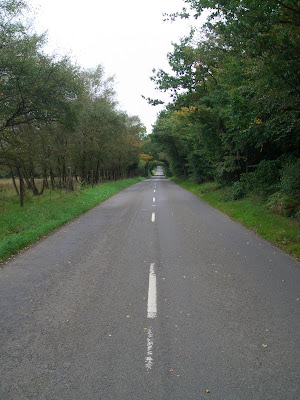
 If we came here again – which we won’t – we would keep to the north of the plantation on the crest of the hill, but somehow we found ourselves stranded on a major road. It mattered little as traffic was negligible, even though the road is probably the only straight one in West Somerset. I was so impressed that I stood in the middle of the carriageway to record it for posterity. I expect that the local boy racers come up here at night and drag their John Deeres and silage bale wrappers.
  We had intended to walk through the woodland known as Britannia’s Shield, planted and divided in imitation of the eponymous patriotic piece of armour. Sadly, there was no obvious access and appropriately, on a day on which a defence cuts scandal broke, half of the shield appeared to have been chopped down.
 We are becoming used to public houses turning out to be semi-public houses. The internet later informed me, not only of the opening hours, but also that for a hundred grand I could buy the lease. I only wanted a pint. We could only shrug our shoulders and study the map for a way back to the truck.
 The rest was pulled down in the middle of the nineteenth century when they built the nondescript edifice which is now the local place of worship. Presumably the worshippers had tired of walking up the hill once a week.
 The track soon led us to Sherracombe Ford where a sign informed us that there had once been an iron bloomery here, obvious from the smelting’s surviving spoil heaps. Well, they probably were there, and probably they were obvious to the archaeologists who had excavated the site a few years previously, but we blinked and still missed this detritus from Celtic-Romano industry.
  It hardly mattered because, as we ascended the almost perpendicular footpath which led away northwards from the track, we were not only blessed with a marvellous view down the combe, but we found ourselves above two circling buzzards as they soared and gyred above the sunlit valley.
 Sadly, every attempt to capture the moment with our little digital camera failed, but soon the mewing raptors, now joined by a third, were mobbed by a squadron of rooks.
 Near the foot of the track a farmer, with the aid of a tractor battery, was shearing sheep. A little further on we came into Bentwitchen, a sleepy huddle of farms, barns, and cottages.
  We walked westwards along the narrow lane, over a stream crossed by the “Irish Champion’s Bridge” as it was named on the map. What fabulous story could lay behind this extraordinary name? We passed a couple of farms, one receiving a major make-over, but not a single vehicle passed us.
 There is everything to like about this splendid pub. New landlords have given the old bar a lick of paint but otherwise nothing has changed.
  Here’s a place where you can sit beneath the pictures of the old timers who have used the pub over the years and of meets of hounds, and enjoy a pint in front of the fire. The beer is still tapped straight from the barrel. We had two excellent pints of Betty Stoggs, brewed by Skinners of Truro, a very decent traditional bitter at 4%. Litehouse, from the Forge Brewery, was also available.
 We had supper here just after the new people, from nearby North Molton, took over, and it remains one of our favourite places to eat out. On this occasion we were enjoying a liquid lunch, but Alan and Pauline Lockwood gave us a very friendly welcome. Good luck to them! Opening hours at present are Tuesday to Saturday, 12.00 pm to 2.30 pm and 5.30 pm to 11.00 pm; Sundays 12.00 pm to 3.00 pm; closed Sunday evening and all day Monday.


 Downstream the water dazzled in the sunlight.
  Near the bank we found a patch of Field Scabious, another wild flower to add to our list.


 As we crossed a cattle grid back on to the open moor, we could see as far as Dunkery Beacon.
  We walked downwards towards Landacre Bridge, and then swung right up the path which led back to Withypool.


 It’s difficult to think of anything more pleasant than sitting in the low black-beamed room, the fire blazing, with a day on the Moor behind you, and before you a pint of Jake’s bitter.


